Sage Advice: The Art of the Ascent
Tom Dunlap’s Legacy in Tree Climbing


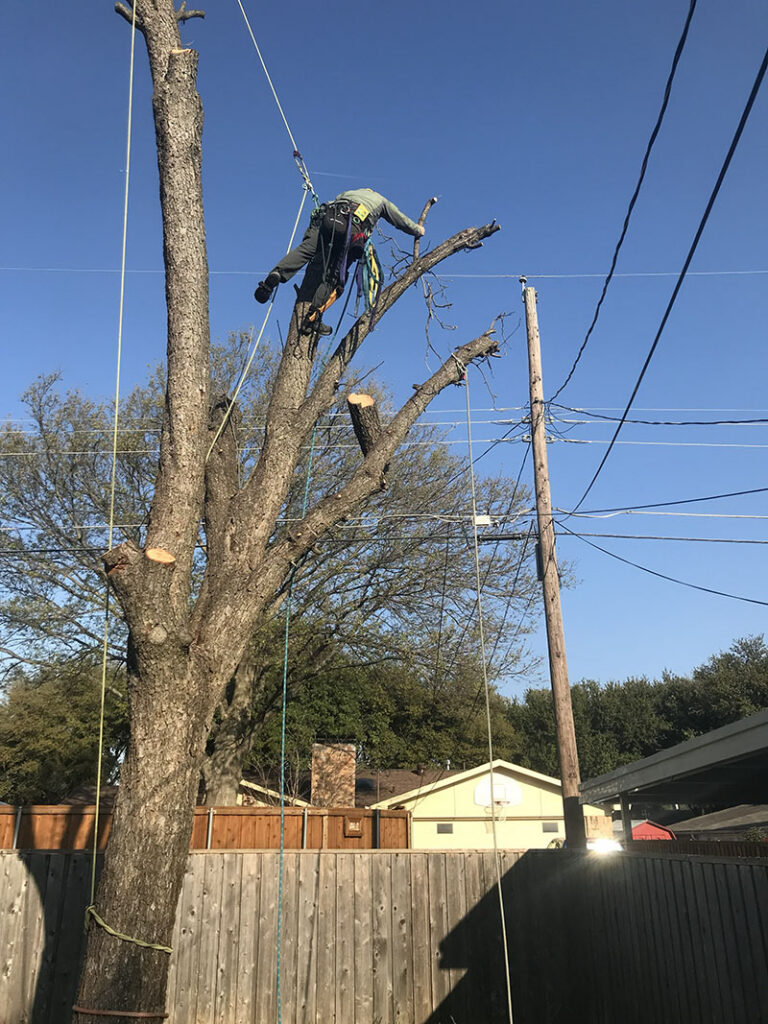
After more than 50 years in arboriculture, Dunlap reflects on the evolution of climbing techniques, the impact of technology on the industry, and his lifelong mission to protect both the trees he loves and the people who care for them.
When Dunlap founded Canopy Tree Care in 1979, he was just 25 years old, but he had already spent half his life in the industry. What he didn’t know then was that he would eventually help shape how arborists approach tree climbing and care.
His early climbing skills were rudimentary, developed under the mentorship of a telephone company pole climber. Although grateful for that instruction, Dunlap began questioning whether conventional climbing methods were the best approach to working in trees.

After graduating from the University of Minnesota’s forestry program, he launched his company with a friend and began attending trade shows and conferences. There, he sought out experienced arborists, absorbed new ideas, and looked for ways to improve his skills.
“I started going to conferences and … listening to speakers, and they’re talking about people that spike-climbed these trees,” Dunlap recalled. “And I said, ‘I don’t want to be that.’”
That realization helped define his career. He set out to develop better climbing techniques while deepening his understanding of tree biology and proper tree care.
Dunlap also began drawing on his recreational pursuits, including rock climbing, ice climbing, and mountaineering. Each discipline offered a different perspective on rope systems, movement, and efficiency. He began exploring how those techniques could be adapted to accessing trees and navigating their canopies.
Over time, his work expanded beyond the field into education, public speaking, and climbing competition judging. He became an advocate for incorporating single-rope techniques into professional arboriculture, helping fellow climbers discover ways to work more safely and efficiently while reducing the physical demands of the job.
Finding a Better Way to Climb
Dunlap’s interest in alternative climbing systems grew through experimentation. One winter, he began testing different ropes, friction hitches, and cord diameters, searching for combinations that would allow him to ascend smoothly, descend when needed, and reliably hold under load.
His goal was to apply what he had learned through recreational climbing to make working in trees more efficient without sacrificing control.
A pivotal moment came in 2005 at a tree care conference in Long Beach, Calif., where he met Morgan Thompson, creator of a device that could travel up and down a rope without requiring the climber to disconnect. That device, known as the Unicender, was manufactured by Rock Exotica.
The encounter opened new possibilities for Dunlap, who was already exploring ways to incorporate single-rope components into traditional climbing systems.
“I was learning to integrate various single rope components to my double rope or MRS [moving rope systems].”
Rather than viewing single-rope and moving-rope systems as competing approaches, Dunlap saw an opportunity to combine their strengths. His interest centered on finding the most effective way to use each system, depending on the task and the conditions in the tree.
Combining SRT and MRS
In a moving rope system (MRS), also known as the double-rope technique, the rope moves through the climbing system as the arborist ascends or descends. In a stationary rope system (SRS), commonly referred to as the single-rope technique (SRT), the climbing line remains stationary while the climber moves along it using compatible equipment.
Both systems have applications depending on the work being performed, the route into the tree, and the climber’s equipment and training. Dunlap recognized that arborists didn’t necessarily need to choose one system over the other; instead, they could combine the two to improve access and positioning.
His approach was to ascend on a stationary rope and then transition to an MRS for positioning within the canopy.
“When we set a rope into a tree, generally we set it up so that one side is clear, [and] it’s not going around or between branches or zigzagging too much,” he explained.
“[On] the other back side of the tree, after it’s gone through a suitable tie-in point, there’s a bunch of branches. So, by climbing single rope, we’ve got a route up the tree that is not over and around other branches,” he added.
Selecting a clear route for the stationary climbing line allowed Dunlap to ascend with fewer obstacles along the way. Once he reached the desired height, he could transition to an MRS for positioning, complete the necessary work, and descend.
He summed up the approach simply: “single up, double down.”
“I didn’t invent SRT,” he said. “But I put my shoulder behind it because there’s so many ways of using it, and that’s a good system. It’s something we can use.”
Dunlap’s contribution was not inventing a new climbing technique but helping other arborists recognize the versatility of stationary rope systems and encouraging them to experiment with different approaches. By demonstrating how SRT and MRS could work together, he helped broaden the industry’s understanding of the tools available to professional climbers.

Protecting the Climber as Well as the Tree
For Dunlap, improving climbing techniques was about more than efficiency. He also saw an opportunity to extend the working lives of professional arborists by reducing the physical demands of climbing.
“By incorporating and changing over from double rope technique to a single rope technique, spending the money to get the gear, and changing their climbing system, they [arborists] realized that their climbing career was extended,” he said.
In a profession that requires workers to climb repeatedly, maneuver through complex canopies, and perform strenuous tasks at height, climbing systems can have a significant impact on both safety and long-term physical well-being.
That concern became central to Dunlap’s philosophy of arboriculture. As he reflected on his career, he developed a personal vision statement that would guide his decisions and the knowledge he shared with others.
“Over time, I thought I should have a personal vision statement,” he said. “And what it came to be was I want to have old, healthy trees and old, healthy tree care workers.”
The statement captured the two priorities that had come to define his work: preserving trees and protecting the people who care for them. Whether evaluating climbing equipment, refining techniques, discussing tree care practices, or teaching others, Dunlap sought solutions that would benefit both.
From the Canopy to the Classroom
Dunlap’s commitment to continuous learning eventually led him to education and public speaking. While attending a keynote presentation by Dr. Alex Shigo, a biologist and plant pathologist widely regarded as the father of modern arboriculture, Dunlap began envisioning a similar role for himself.
“My goal was to know a topic and know enough about something that I’m called on to speak,” he said.
Just as mastering climbing techniques required years of practice and experimentation, becoming an effective educator demanded deep subject knowledge and the ability to communicate it clearly. Dunlap devoted years to studying, conducting training sessions, and developing his presentation and public-speaking skills.
He began by providing basic tree-climbing instruction to companies without compensation. Those early efforts eventually led to presentations and workshops at national and international events.
His contributions also extended to the professional community through competition judging and leadership roles with the Minnesota Society of Arboriculture (MSA). He served as a program and education chair and as a tree-climbing championship chair, helping support educational opportunities and the development of climbing skills within the industry.
“Being able to be included in doing local and chapter events and being asked to be a part of the judging team over the years, it’s quite a privilege,” he said.
For Dunlap, these roles offered another way to share what he had learned and help the next generation of arborists develop their skills.
A Legacy That Continues to Climb
Although Dunlap hasn’t climbed a tree in a decade, he remains connected to the industry and the people who continue to advance its knowledge and practices. His last climb was an ash tree removal for the city of Minneapolis.
One of the most rewarding aspects of his career has been meeting arborists who remember hearing him speak early in their own careers and later adopted his ideas in the field.
“It’s been very exciting to see how people have incorporated these techniques, especially single rope and stationary rope,” he said. “So, it feels good to have left that legacy.”
That legacy extends beyond any single climbing system. Through years of experimentation, teaching, and advocacy, Dunlap helped encourage arborists to question established practices, explore new techniques, and consider how their work affects both trees and the people who care for them.
As he looks ahead, his focus has shifted from reaching new heights in the canopy to exploring the world beyond it. He hopes to travel, discover new places, and visit friends along the way.
It’s a fitting next chapter for someone whose career has been defined by curiosity, a willingness to challenge convention, and a commitment to making tree climbing safer and more efficient—all while enjoying the trees he has spent a lifetime protecting.