The Case for Tree Care Machines
Efficiency, Safety, and Smart Investment


Este es nuestro intento de convertir las historias en audio español usando Inteligencia Artificial. Aún así le recomendamos que reconfirme ciertas palabras clave y temas. ArborTIMES no garantiza ni se responsabiliza de la conversión del inglés al español de los relatos.

Manual work is a defining characteristic of the tree care industry. In its purest form, jobs are completed with chainsaws, slowly working to fell trees and trim back overgrowth by hand.
As technology has improved and companies seek more efficient ways to do their work, mechanical tree removal has become a more common approach, especially with utility and right-of-way work that requires precision cuts in tight quarters.
But is it always the best method? And when does it make sense for a company to invest in this equipment?

Mechanical Means Fewer Risks
Improving job site safety benefits not only individual workers but the entire organization. According to Greg Roberts, tree care manager at Sennebogen, one of the key advantages of mechanical tree equipment is the increased level of safety it provides.
“It makes the job site a lot safer,” he said.
By using mechanical equipment, workers can be kept at a safer distance from falling debris and other hazards. These machines offer greater control over how and where branches or whole trees are brought to the ground, reducing the unpredictability often associated with manual felling and helping protect crew members on the ground.

“You have positive control of that tree all the way to the ground,” Roberts added.
DC Creekmore, senior account manager for Altec’s tree care line, echoed this perspective, noting that mechanical removal significantly reduces time spent in the canopy and limits the number of personnel needed in the drop zone. Additionally, the cab of a tree care machine provides a physical barrier that offers another layer of protection.
“I don’t know of a safer way to remove a tree,” Creekmore said.
Cutting Job Times in Half
Manual tree felling with large crews is a time-intensive process. A single job can take an entire day or more, limiting how many projects a company can complete based on worker availability and speed. According to Creekmore, the efficiency of mechanical equipment is a major reason companies adopt it.
“You can divide and conquer,” he said, explaining that some companies complete jobs in half the time compared to manual felling.
Roberts added that some companies now trailer machines from job to job throughout the day to maximize productivity.
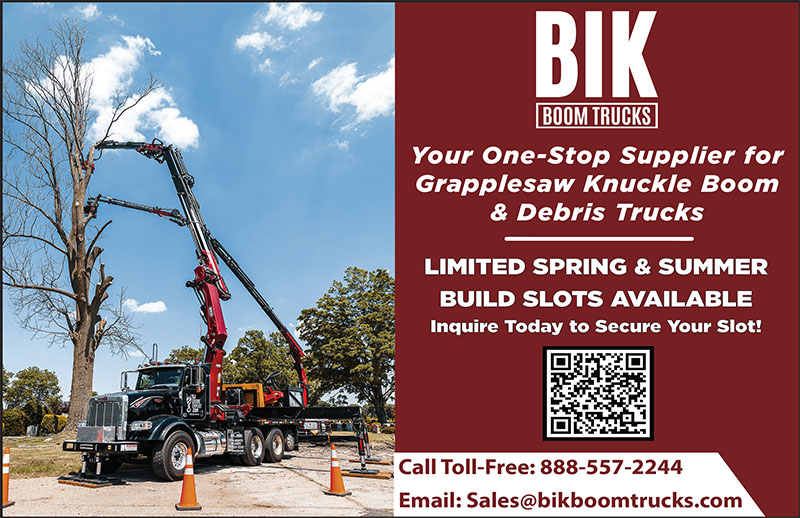
Kyle Biancardi, tree care specialist at BIK Boom Trucks, said he has seen similar results. He recalled one company that previously completed one to two jobs per day. After purchasing a grapple saw truck, they increased their capacity to four or five jobs per day—without hiring additional crew members.

For small to mid-sized companies, this kind of productivity leap can fuel growth.
“Any tree company that has a plan to grow has to have a plan,” Roberts said. “It’s a volume business.”
He emphasized that, at some point, equipment becomes necessary for scaling operations.
Biancardi added that improved efficiency benefits everyone. Completing jobs faster gives crews more time off, helps prevent burnout, and frees company leadership to focus on sales and business development.
“This is the only piece of equipment they’re going to buy that’s actually going to grow their business,” Biancardi said. “You’re buying your time back.”

Creekmore and Zak Hilliard, market manager at Altec, noted that while the tree care industry has traditionally been slow to adopt new technologies, attitudes are shifting.
“We’re seeing a change in the mentality around the best way to get the job done,” Hilliard said.
“For years, the tree care industry has been untouched by mechanized innovation,” Biancardi agreed.
Over the past decade, adoption has accelerated, with many machines now featuring versatile attachments beyond tree felling.

“Anything that has to do with vegetation, we have an attachment,” Roberts said.
He explained that Sennebogen’s quick coupler system allows for easy switching between nine different attachments, including mowers, mulchers, and hedge trimmers. These options make the machines highly effective in confined spaces where manual trimming would take significantly more time.

Things to Consider Before Buying
Despite their benefits, tree machines come with considerations. Due to their size, they typically require a trailer for transport between job sites. As a result, companies must either subcontract hauling or own the appropriate transport equipment.
In many cases, machine operators must hold a commercial driver’s license (CDL), and there is a learning curve for new users. To address this, Sennebogen offers training and collaborates with third-party organizations that use simulators to help crews become familiar with the equipment.
“We have what we call machine familiarization,” Roberts said.
Biancardi noted the importance of working with a manufacturer who is committed to ensuring customers understand how to use and maintain the equipment. BIK Boom Trucks, for example, partners with a company that offers crane operator certification and provides onsite training to clients with their newly purchased equipment.
“You need training,” Biancardi said. “It’s in your best interest.”
When is It Worth the Investment?
Tree care machines represent a significant financial commitment, often costing several hundred thousand dollars. For many companies, it is their largest equipment investment.
Creekmore sees the purchase as an investment in future capacity and safety rather than a simple expense.
He recommends a simple formula: if the revenue from one successful tree job per month can cover the machine payment, it may be a worthwhile investment.

Biancardi emphasized that the decision should be based on a company’s long-term vision, not just current operations.
“Look at your business not as it is, but as you want it to be,” he said.
For companies currently renting machines, Biancardi suggested reviewing rental costs and utilization rates to determine whether ownership would be more economical.
In tight labor markets, Roberts, Creekmore, and Biancardi all agreed that machines can help offset worker shortages by boosting output with smaller crews.
Safety and Efficiency Go Hand-in-Hand
For companies working in confined spaces — such as utility and right-of-way corridors — mechanical equipment can be a game-changer, offering both safety and efficiency.

“If you’re reducing labor, you’re ultimately making the job site safer,” Roberts said.
While training and transport logistics are required, the long-term gains often outweigh the challenges. Increased productivity, safer operations, and improved work-life balance make tree care machines one of the best investments a company can make.
After all, there are few greater returns than buying back your time — and keeping your people safe.