The Green Canopy Report
Forecasting Tree Health in 2026



The confluence of climate change, human development, and invasive species has created a perfect trifecta that erodes the natural defenses of our urban forests, pushing them to the brink of collapse. But within this crisis lies an opportunity for change.
As our world grows and changes, cities around the world continue to fight a wave of mounting threats against their green spaces. Urban and community forests are facing challenges like never before, constantly under siege from emerging epidemics that threaten the resilience and long-term survival of our trees.
How we design, value, and steward our urban forests can have a lasting impact that not only helps trees withstand today’s pressures, but also stands the test of time against the future’s challenges.
When these conflicts come knocking on our door, it’s time to rally together to defend, restore, and reimagine what care looks like for the urban forests that sustain us.

Exhibit A: invasive species
The presence of invasive species in urban forests is not new, though its scope and impact on trees increase significantly every year. According to a research study published in 2022, it is estimated that 1.4 million street trees in the United States will be decimated by insects from 2020 to 2050, costing an annualized average of $30 million. Ninety percent (90%) of these mortalities are expected to result from a very tiny, very familiar adversary.
Emerald Ash Borer

The prolific tyranny of emerald ash borer (Agrilus planipennis) has been raging for decades since it was first detected in 2002. This scintillating jewel beetle from northeast Asia has all but captured the heart of the Midwest and is en route to populate the rest of the continent in the coming years. With no signs of slowing down anytime soon, EAB is causing considerable alarm in many ash-dominant communities across North America.
“Look for D-shaped holes in the tree and dieback [in the canopy],” Robert Caffrey, owner of Caffrey Tree & Landscape LLC advised.

Other EAB symptoms include bark blonding, S-shaped larval galleries, and woodpecker activity.
Spotted Lanternfly
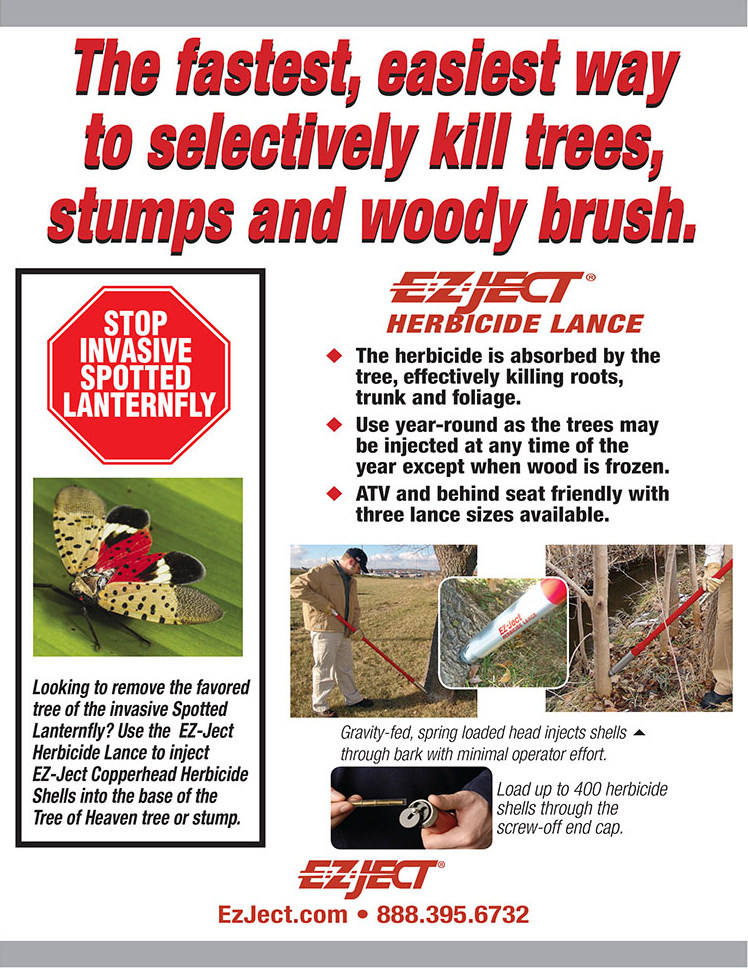
Spotted lanternfly (Lycorma delicatula) is another heavy hitter in urban forests, having quickly moved along the east coast while inching its way closer into the South. David Whisple, PHC manager at Barrett Tree Service East, emphasized how widespread the spotted lanternfly (SLF) has become, noting its presence in the most surprising places.

“Spotted lanternfly is popping up in many areas as the public is becoming more familiar with them,” he said. “The tough part about them is that they lay their eggs on almost anything — cars, benches, siding, etcetera. This makes it very hard to apply treatment in landscapes.”
Nicole Carpenter, president of Black Pest Prevention, anticipates that longer, warmer growing seasons will contribute to more unwelcome sightings of this and many other pests.
“In the Northeast, that [weather] gave spotted lanternflies and magnolia scale extra time to feed and lay eggs,” Carpenter explained. “So, we should expect a pretty heavy lanternfly nymph hatch in 2026, especially on maples and ornamentals.”
Magnolia Scale
Tipping the scales at one half-inch, magnolia scale (Neolecanium cornuparvum) is the largest soft-scale insect in the US. Even though it is a native insect, magnolia scale continues to be a growing concern in many ornamental landscapes, resulting in an exponential number of calls from homeowners seeking solutions for this problematic pest.
“Magnolia scale was very tough for us to control in 2025,” Whisple recalled. “It was a very popular topic for clients as well as sales arborists at site visits.”

According to the PHC manager, magnolia scale is hard to miss, and the honeydew it drops leads to sooty mold that coats the plants beneath it. That sticky buildup often draws stinging insects, which can be a real concern for families with children spending time outdoors.
In addition, the pest’s proliferation has been steadily increasing in recent years, though its future impact on ornamental landscapes remains to be seen.
“Populations seemed a bit higher in 2025 than the last number of years, so it will be interesting to see how that translates in 2026,” Whisple concluded.

Beech Leaf Disease
Beech leaf disease (BLD) is a lethal disorder affecting beech trees (Fagus spp.), caused by the parasitic nematode (Litylenchus crenatae ssp. mccannii.) Effective treatments have been developed for specimen trees and further management research is ongoing.
Diseases also pose a significant risk to tree health. Virulent pathogens can quickly multiply and disrupt a tree’s physiological processes, resulting in diminished canopy cover over time. The rise of one emergent disease has left many industry professionals feeling increasingly uneasy, raising serious concerns for the future of our beech forests.

“The threat I am most concerned about is the rapid spread of beech leaf disease,” Tammy Sons, founder & CEO of TN Nursery confided. “Native beech trees are being decimated by this disease, and research is still underway to learn how to manage it.”
Dr. Matthew Borden, research scientist/plant pathologist at Bartlett Tree Research Laboratories reported how BLD detections are surfacing in areas where the disease had not been documented before, a warning that invasive species recognize no boundaries and can impact communities everywhere.
“Beech leaf disease continues to dominate concern among tree and nature-lovers in much of the Eastern United States,” he said. “Just last month, I visited the first site of BLD discovery in North Carolina, with the nematodes having made, rather inexplicably, their way to yet another new state.”

Dishonorable Mentions
There are many other pests to watch for in 2026. Oak wilt (Bretziella fagacearum), laurel wilt disease (Harringtonia lauricola), Phythoptera blight and root rot (Phytophthora spp.), spongy moth (Lymantria dispar dispar), hemlock woolly adelgid (Adelges tsugae), box tree moth (Cydalima perspectalis), and southern pine beetle (Dendroctonus frontalis) are just a few contenders that urban foresters should keep an eye out for.

Kevin Brewer, Northeast regional technical manager at Arborjet | Ecologel warned that climate will play a critical role in shaping the epidemiology of future pest infestations.
“Trees in the Northeast and Midwest are being exposed to new disorders, and climate change is a major influencing factor,” he said.
Under Pressure
Climate change is a major driver of the urban forest health crisis. Phytopathologists, entomologists, and plant health care specialists have long forewarned the convergence of climate with other stressors and the deleterious consequences for forest health and survival. Many experts stress that this phenomenon may lead to additional obstacles in the landscape.
“Some US states are experiencing warmer and longer falls than average this year, and this can easily turn into a pest problem for trees in 2026,” Carpenter warned. “Longer fall with higher temperatures than average means pests stay active longer and lay more eggs, and this results in bigger populations next year.”
Climate change impacts are also evident at the regional scale, where abnormal weather patterns intensify the severity of tree disorders.

“The Northeastern United States is projected to continue experiencing notable effects in the form of more precipitation as rain rather than snow paired with warmer winter temperatures,” Borden noted. “While an extended growing season or less snow may sound welcome to some, diseases like Phytophthora can also benefit from extended periods of cool, wet soil conditions.”
Even though hundreds of urban trees die every year, pestilence is not always to blame. Many tree problems are caused by concurrent contributing factors, with abiotic disorders like drought stress, freeze-thaw damage, soil compaction, and improper tree care acting as a catalyst to lure in opportunistic or secondary pests.

Sons explained the dynamism of environmental pressures and how they feed into a tree’s susceptibility to pests and diseases.
“Longer periods of heat and less predictable rainfall patterns will weaken tree health and make them more susceptible to pest invasions and stress,” she cautioned. “Think of it as a one-two punch, with drought weakening the tree and then a pest taking it out.”
If a tree is burdened under the weight of too many kinds of pressure at once, it can enter a steady decline known as the “mortality spiral,” where each stress compounds the next until recovery is no longer possible. This is a pressing challenge for urban foresters who find themselves racing against the clock to mitigate the impacts of climate change.
Many tree care professionals are turning back time by returning to provenance, selecting species that are progressively adapted to the local climate challenges to restore balance and lay the groundwork for healthier, more resilient urban forests.
“In the long term, we need to plant regionally adapted, pest-resistant natives in order to have less of a landscape-scale loss,” Sons stressed.

Ultimately, caring for trees amid climate change means recognizing that they are part of a larger system, one that is constantly shifting and adapting in an ever-changing world. This is why the concept of “right tree, right place” is now more important than ever, as thoughtful choices today can shape the longevity of the landscape tomorrow.
“The entire landscape is a living, evolving entity, and it will change with weather patterns and natural plant and insect life cycles,” Whisple reflected. “Any tree or planting will struggle if it is not in the correct environment.”
Ready, Set, Action
Fighting back against key threats and challenges is no easy feat, but there is hope. Early detection of pests, diseases, and other challenges in the landscape helps prevent problems before they start, providing plant healthcare professionals with a decisive advantage in maintaining tree health.
“Early monitoring in the field will be key,” Whisple noted.

Effective monitoring is the critical first step, but what should we do when communities are already facing an onslaught of pest attacks?
“The toughest part about dealing with invasive insects is that preventative options aren’t always available at the onset of pest pressure,” Brewer observed.
Meet integrated pest management (IPM).
With a toolkit of preventative, cultural, physical, biological, and chemical controls, IPM uses a combination of effective, environmentally sensible methods to create a standard for managing pests, diseases, and other challenges in urban forests. Because of this holistic philosophy, it is important to adopt a “forest for the trees” perspective and evaluate all possible interventions when developing treatment plans for trees.

“To allow us to successfully implement the process of integrated pest management, we have to react to the landscape in real time with effective techniques that take the whole picture into account,” Whisple emphasized. “It isn’t always about jumping right into chemical intervention.”
There are absolutely times when that approach is needed and worthwhile, but it is just as important to regularly assess the landscape for pests and diseases and use additional strategies alongside it.
Effective IPM practices may involve physically removing eggs, juveniles, and adult insects from trees by hand or with water.
Other techniques include:
- Installing barriers or traps, selectively pruning dead, damaged, or diseased material,
- Releasing applicable biocontrols,
- Applying targeted pesticides,
- Choosing appropriate tree species, and
- Cultivating a desirable growing environment for trees.
Even though chemical controls have declined in recent years, they still serve an important purpose within an IPM program.
As Borden explained, “While we cannot rely solely on chemical tools, diversifying modes of action is important to reduce the risk of resistance development.”
His point underscores why PHC professionals continue exploring new chemistries and application methods rather than abandoning them altogether.
That perspective has become especially important as emerging pests and diseases spread across North America. Recent advances in pesticide technology are offering new hope — particularly in the battle against BLD. Experts from around the country are testing these tools, comparing notes, and sharing what is showing early promise in their own landscapes and plant healthcare programs.
Brewer is among those reporting encouraging results.
“PHOSPHO-jet injections have yielded promising results in the fight against beech leaf disease,” he noted. “Canopy health trials conducted on Long Island, New York show excellent nematode control, particularly when paired with the 9-gallon AMP I.V. injection system.”
His team’s experience highlights how injections are evolving to better target BLD at the canopy level.
Meanwhile, other professionals are seeing progress with different delivery systems.
“We are seeing promising results with foliar applications of a nematicide called Fluopyram. As we are following the science in real time, the industry is finding that we can get acceptable coverage at a lower rate than originally thought,” Whisple reported.
His observations suggest that foliar applications may offer flexibility and efficiency as the industry learns more about rate optimization.
Research at the national level is pushing innovation even further.
“The EPA recently approved a new line of nematicide products containing an active ingredient which is highly effective on the group of nematodes that includes the BLD-causing pest,” Borden explained. “While the new tool has the same mode of action as the current and very effective fluopyram-based treatment, the advantage is the potential for a soil-applied treatment for root uptake. We plan to evaluate these products as they become available.”
His team’s upcoming evaluations may open the door to additional, more accessible treatment options.
Tree care is never one-size-fits-all. When it comes to IPM, true success depends on recognizing the individuality of each tree and developing management plans tailored to specific needs and vulnerabilities.
“Every tree is a unique living thing and will respond differently,” Whisple stated. “It is important to monitor and take into account all of its surroundings and stressors to find the best method of treatment to help it flourish.”

Next-Gen Forests
The future of the urban forest rests in our hands. As industry professionals, we have a choice. We either allow these challenges to crumble the green infrastructure of our cities, or we rise to meet and overcome them. Real success will come from restructuring how we protect and manage the urban environment, focusing on what lies within our control and working with nature, not against it.
“We are, in most cases, not working in natural environments,” Borden stressed.
Although some environmental stressors are beyond our control, many landscapes face a host of more immediate, routine pressures. Problems like soil compaction, major soil disruption, low organic matter, salt exposure, inefficient irrigation, and planting the wrong species in the wrong location are widespread — and often issues we can actively address.
“Focus on the numerous cultural issues we can control and alleviate,” Borden continued. “Diversify the urban canopy where possible, address soil issues, and recommend better plant material and good quality nursery stock.”

Likewise, Brewer supported analyzing environments holistically.
“Healthy soil produces healthy trees,” he shared. “So even if your region isn’t currently affected, there are always steps that can be taken to improve the growing environment. And keep current on at-risk tree species and the associated threats moving into your region.”
In a world where invasive pests and diseases continue to shift and spread, shared responsibility is the cornerstone to preserving the legacy of our urban forests. Without decisive action now, the trees we cherish may vanish before people ever get to know them. Only by responding with care can we honor our responsibility to current and future generations, passing down the gifts that trees provide for us all.
About the Author
TJ Yurko is an ISA Certified Arborist® (PR-5403A), ISA TRAQ Arborist, and Certified Landscape Horticulturist Technician at his company, Tree J Consulting, where he advises clients on urban forestry and arboriculture best management practices and strategies for tree care operations.