Against the Odds
Preserving a Cottonwood in Clayton


Cottonwoods can be a difficult species to work with. Their wood is often described as little more than structural pulp. They have a tendency to develop cavities that compartmentalize poorly, and their limbs seem almost predisposed to failure. As a result, cottonwoods are frequently judged by their defect profile rather than their potential, especially when they occupy sites where people or property are at risk.
So, when it came to preserving the mature cottonwood that stood in a St. Louis suburb, it was no surprise that more than 80 percent of the tree services that submitted proposals recommended removal.
Saving the tree required a different approach — one rooted in risk management rather than risk avoidance. It meant embracing the coarse beauty of an aging cottonwood and implementing a preservation plan that combined both mechanical and chemical interventions. The strategy was straightforward: first, perform a full suite of ANSI A300-backed pruning operations; second, follow the pruning with a plant health care program designed to improve soil conditions, restore nutrient availability, and encourage root development.
The goal was not to make the tree immortal. The goal was to make it perform better.
Reducing Competition
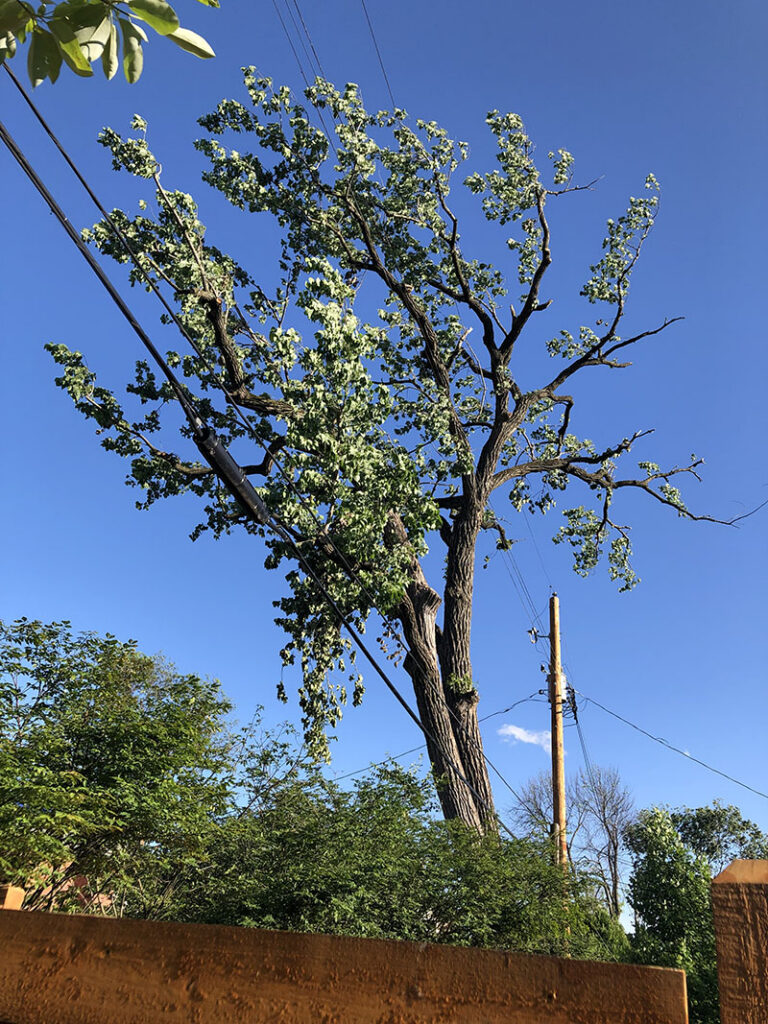
Two adolescent elm trees were growing directly within the cottonwood’s critical root zone, nearly touching its trunk. Above ground, their canopies threatened to create future structural conflicts. Below ground, they functioned as highly effective competitors for water and nutrients.
This competition mattered.
The property was unirrigated, and St. Louis summers routinely bring multiple periods of drought within a single growing season. Under those conditions, every gallon of water and every available nutrient becomes increasingly valuable. Removing the elms represented the first major decision in the preservation plan and immediately reduced competition for resources within the root zone.

The Turner Brothers and Determining Feasibility
“Jason was the first to look at the tree. Then he had me come out and look at it. The question we had to answer was, ‘Was the work even doable or practical for a climbing arborist to do?’ When I first looked at the tree, I had no concerns about it,” said E.J. Turner, who owns Turner Tree Specialists alongside his brother, Jason.
“Other companies were concerned about the liability involved with working on a tree like this. Ameren had been pruning the tree for years prior to our work. I could tell a lot of weight had already been removed from the tree.”
Turner Tree Specialists were selected to perform the aerial work. Their involvement was critical.
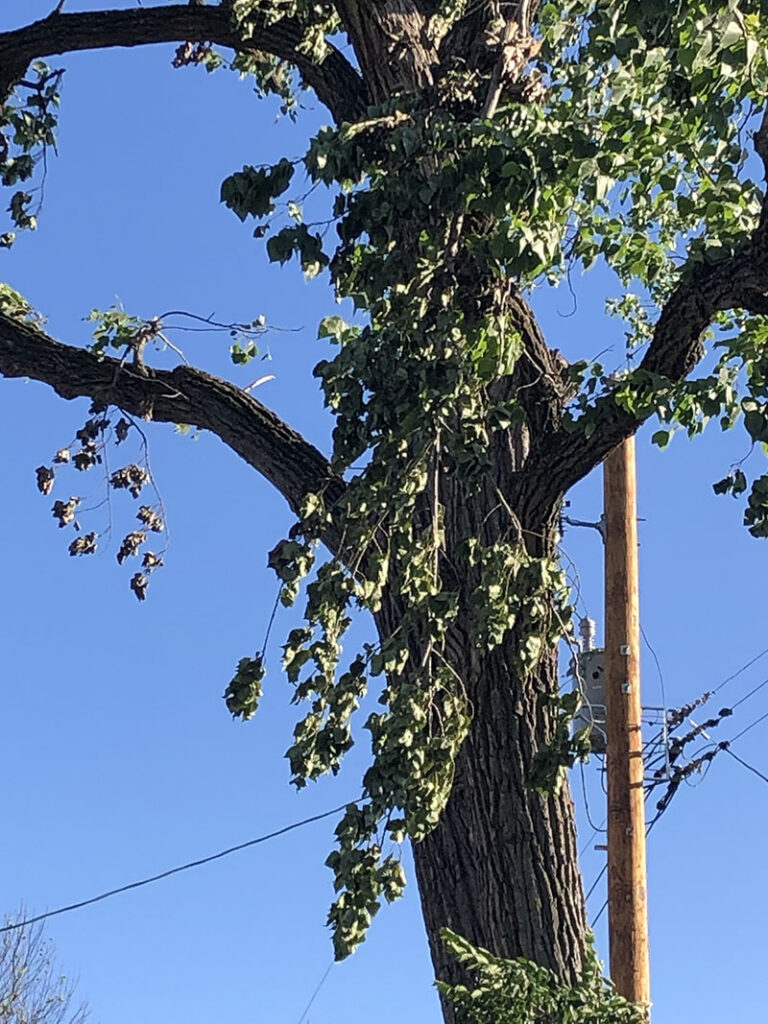
The brothers have built a reputation for executing custom pruning prescriptions on technically challenging trees, and this project demanded exactly that skill set. Beyond their climbing ability, both men had prior experience as Qualified Line Clearance Arborists, expertise that would prove valuable given the tree’s relationship with nearby utility infrastructure.
Jason viewed the tree pragmatically.
“I didn’t think the tree needed to be cut down,” he said. “I told her, as long as you’re willing to invest in the ongoing maintenance of this tree, I think it’s reasonable to expect another three to five years out of it. But it’s going to be costly. It’s not going to be a one-time expense. You’re going to have to stay on the pruning cycles and continue maintaining it.”
That conversation became the foundation of the project. Preservation was possible — but only with realistic expectations and a commitment to ongoing care.
Pruning Objectives and Access Methods
The pruning prescription called for deadwood removal, the elimination of crossing and interfering branches, and reduction cuts on overextended limbs carrying excessive weight.
For a species that often struggles to compartmentalize wounds effectively, restraint was just as important as intervention. Enough material needed to be removed to improve structure and reduce loading, but pruning wounds had to remain as small as possible to support recovery.
The challenge was finding that balance.
To access the tree safely and efficiently, two methods were selected: aerial lift operations and rope access.

Rope Access Considerations
The cottonwood’s long, gangly architecture made reaching branch tips particularly difficult. Yet those branch tips were precisely where many of the reduction cuts needed to occur.
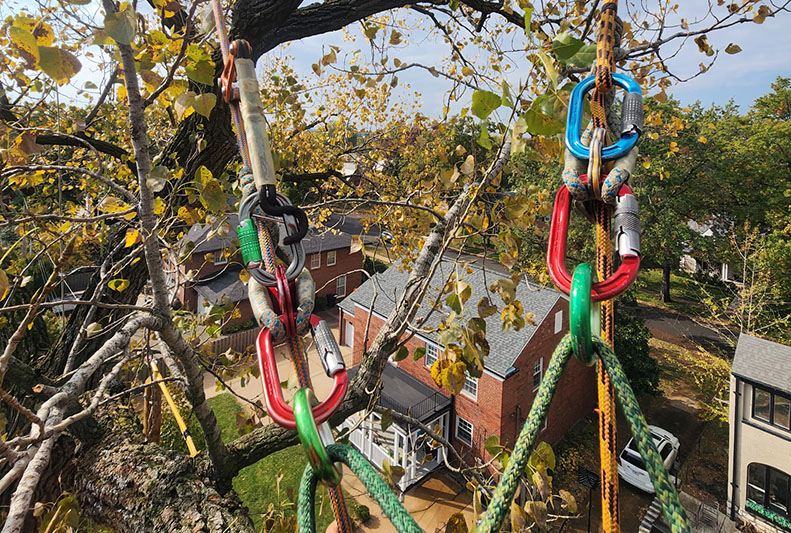
For improved access and work positioning, E.J. employed an SRS system as his primary climbing system while installing an MRS system as a secondary system for one particularly challenging section of the crown. Each system was anchored independently in larger-diameter wood to provide additional security within the softwood structure.
The dual-system approach allowed him to move through the canopy with greater precision and control.
Complicating matters further, portions of the tree occupied space within the Minimum Approach Distance of nearby high-voltage conductors. Any rigging operation had to control cut material without allowing excessive swing.
Drawing on their line-clearance experience, the Turners used a combination of natural-crotch rigging for lighter material and blocks and pulleys for larger sections. Every piece was directed toward a limited landing zone accessible only through the client’s backyard — a drop zone representing little more than a narrow slice of the canopy footprint.
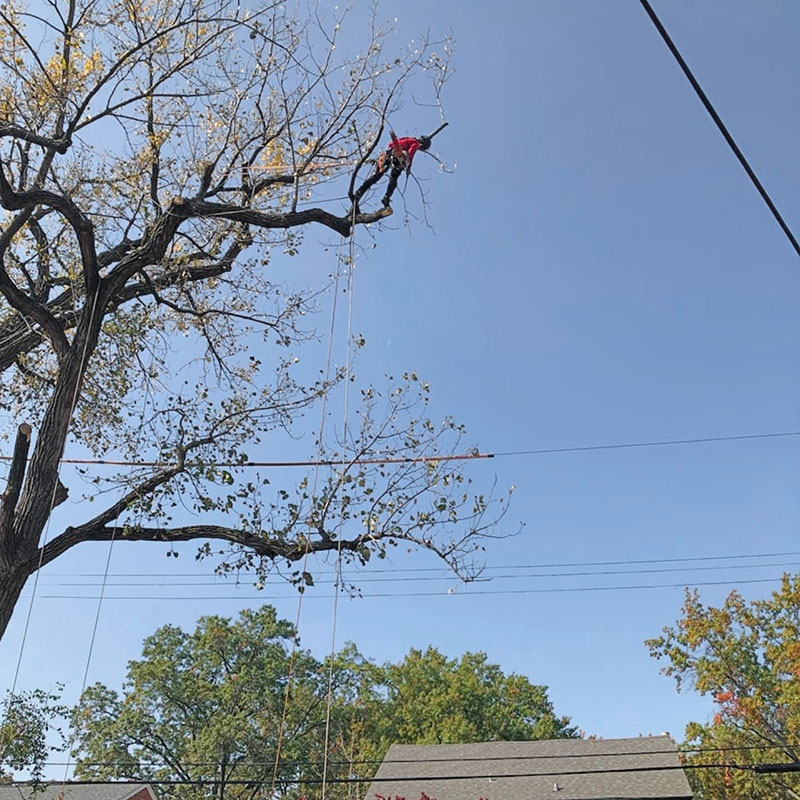
On the west side of the tree, E.J. traversed limbs extending beyond primary utility conductors to access deadwood slated for removal.
The operation demanded complete control.
Nothing could contact the electrical infrastructure. Gear was secured and
double-checked. Climbing and rigging lines were routed carefully to avoid utility contact. Throughout the process, E.J. balanced rope management, work positioning, and hazard awareness while maintaining safe access to the tree’s outermost sections.
Aerial Lift Considerations
Even positioning the aerial lift required unusual care.
Large surface roots radiated outward from the base of the tree, and erosion had created voids beneath portions of the root system. These areas were particularly susceptible to damage under concentrated loading.
Driving across them — or setting outriggers directly over them — risked breaking roots that were already exposed and vulnerable.
As a result, lift placement had to be planned with the same level of attention devoted to the climbing operations themselves.
Pruning Outcomes
Reduction pruning ultimately represented the largest portion of the work performed.
Primary, secondary, and tertiary branches were all selectively reduced in accordance with natural-target pruning principles. This approach accomplished several objectives simultaneously.
First, canopy mass damping was preserved as much as possible. Second, reduction cuts removed foliage and end weight without creating excessive stress on parent stems. Third, branch length and loading were reduced in ways intended to decrease bending moments and lessen the likelihood of large limb failures.
Most importantly, the pruning achieved its objectives without compromising vigor.
The tree retained its natural appearance. Epicormic sprouting remained limited. Recovery was strong. And as of this writing, the cottonwood has not experienced catastrophic whole-tree or large tree-part failure.
Plant Health Care Treatments and Results
Following pruning, Xavier Kaighin of Diamond Edge Outdoor Management administered a plant health care program that included paclobutrazol (TGR) applications and fertilization.
The response was dramatic.
Combined with the removal of the competing elms, the treatments produced a substantial increase in leaf size across the canopy. Site observations conducted in the fall of 2025 suggested average leaf size had increased three to four times over pre-treatment conditions.
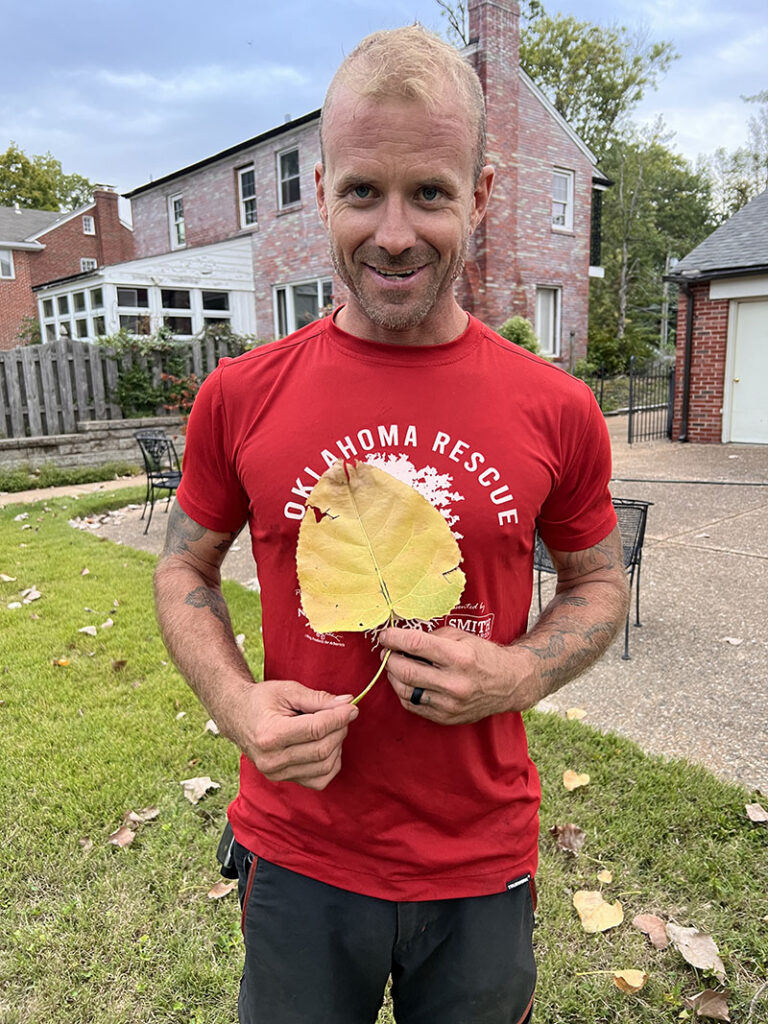
For a tree that had never previously received fertilization, the improvement was impossible to ignore.
Closing Remarks
“It’s not very common in my practice to preserve a cottonwood,” E.J. admitted. “It’s one of the rare trees people ask us to save. Most often, we’re cutting cottonwoods down.”
Then nature provided the ultimate test.
On May 16, 2025, the recommendations, pruning prescription, and preservation strategy were put to the test when an EF3 tornado struck the St. Louis area. Wind speeds reached approximately 152 miles per hour, leaving a path of destruction across the urban forest.
Mature oaks failed. Large shade trees that had stood for generations were dismantled by the storm. Streets filled with debris from both homes and trees. Entire canopy corridors disappeared.
A swath now exists immediately east and west of the cottonwood where tall shade trees once stood.
Yet somehow, the cottonwood endured.
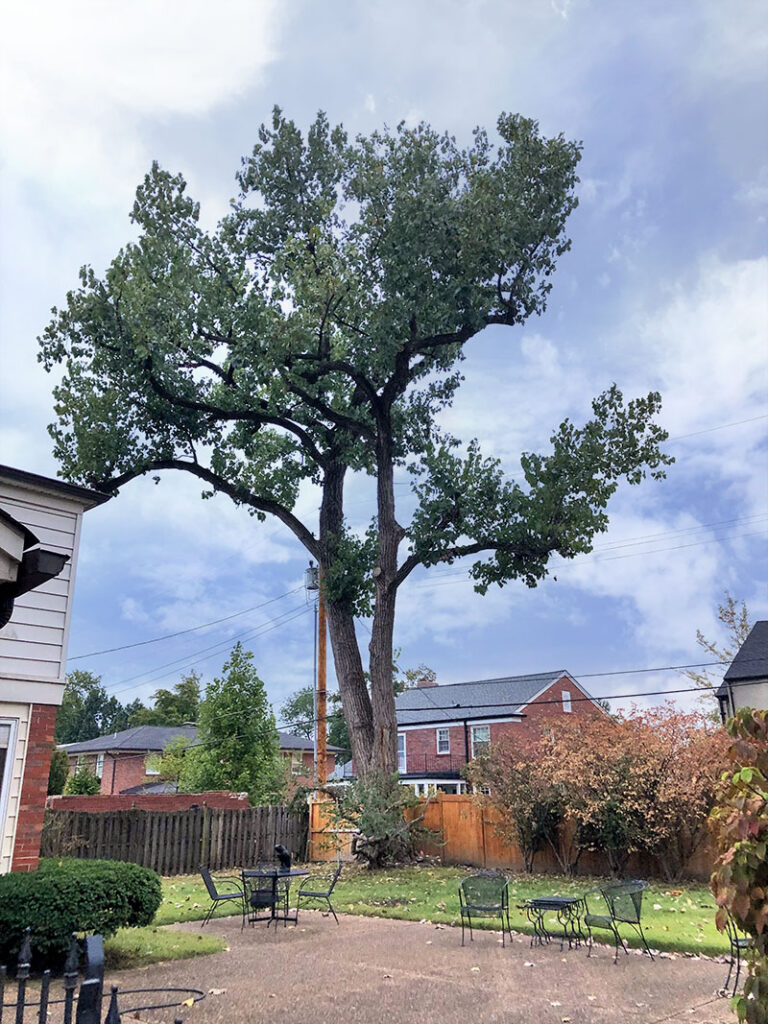
From a biomechanical standpoint, the tree performed better than anyone involved could have reasonably expected. It did not throw large limbs. No major structural failures occurred. Only small- and medium-diameter branches were lost during the storm.
Can pruning improve a tree’s performance during severe weather events?
Without question.
Can pruning, fertilization, and growth regulators make a tree immune to extreme weather?
Absolutely not.
But seeing a tree that had divided professional opinion, challenged conventional recommendations, and required significant investment survive an EF3 tornado was extraordinary.
For the Turners, the client, and everyone involved in developing the preservation plan, it was a reminder that thoughtful arboriculture cannot guarantee outcomes — but it can meaningfully improve the odds.
And sometimes, those odds are enough.
About the author
Ryfe Greenwood is a pseudonymous writer, arborist and Tree Care Services Business Developer at BrightView Commercial Landscapes where he advises clients on general tree and plant healthcare strategies tailored to maximize property and landscape value.