Micro Vs. Macro
Making the Right Call with Tree Injections



Even in the age of the laser-guided “intelligent sprayer,” the shift away from broad-spectrum foliar spraying is only accelerating.
First, there’s the issue of simple ineffectiveness: After all, depending on wind, sunlight and the time of year, a good number of those chemicals may never reach the target plant. These sprays also like to go wherever they want — including where they shouldn’t: A 2024 study from the Illinois Department of Natural Resources looked at 185 different woodland, grassland and wetland sites across the state and found 41 different chemical compounds — with at least one found at 97% of the sites.
Of course, liability for arborists is also higher with spraying, which means increased insurance rates and more regulatory hoops. And with the EPA acknowledging that bystander exposure should be expected even under proper application, pros face a level of public scrutiny like never before.
“They assume if you show up with a spray truck, you’re spraying Agent Orange … and their kids are going to have six toes,” said Chip Doolittle, president of Omaha-based ArborSystems. “So, you’ve got a giant weight around you if you’re just spraying trees.”

Of course, as spraying has declined, trunk injections have grown: From some of the first pre-filled capsules in the 1960s to the innovative low-pressure, micro-injection tools of today, arborists are increasingly implementing these more precise, environmentally contained alternative treatments for insect control, disease prevention and nutrient administration.
Today, arborists are taking advantage of a variety of micro-injection and macro-injection treatments, but when is each one most appropriate — and what should arborists consider before choosing?
Micro-injections: Precision Delivery for Modern PHC
Bret Cleveland is the owner of Urban Tree Specialists in Kansas City, Missouri, and has seen the rapid evolution of plant health care firsthand over the last 25 years.
“When we first started and were applying iron, we were just drilling holes around the base of the tree and dumping straight chelated iron in,” he said. “The tree would turn green for a year, and then we’d do it again. Now, we use the micro-injection method much more often. You can dial it into the size of the tree, so it’s literally down to a science. We’ve come a long way.”
In fact, a micro-injection has become the new delivery standard for many pesticides, micronutrients and fungicides, delivered by drilling a small, shallow hole (typically up to 3/8-inch deep) around the root flare. The concentrated product is injected into the xylem or sapwood and distributed through the vascular system via the natural sap flow, delivering the chemicals to branches, leaves and roots. Micro-injections are also defined by the amount of chemical administered: usually just one to five mL per site.

It was the scourge of the emerald ash borer (EAB) that really served as the turning point for micro-injections, said Kevin Brewer, northeast territory technical manager for Arborjet Ecologel, a manufacturer of many of the chemicals used in the technique.
“Tree injections became the gold standard to successfully treat pests,” he said. “It really opened people’s eyes to the effectiveness of it, the ease of it, and the sustainability of it.”
One of the most effective chemicals for EAB is emamectin benzoate, which can also provide multi-year control for two-lined chestnut borer and bronze birch borer, as well as seasonal control of Japanese beetle, bagworm, oakworm, and others. Brewer said the higher concentration means quicker delivery.
“You can set the equipment to however many milliliters and just give it one port,” he said. “Then you’re giving it an even distribution around the base.”
Of course, micro-injections aren’t the silver bullet for every plant health care scenario. If the tree is too large or too compromised, or if uptake conditions are poor (due to excessive heat, cold or saturation), the outcome may not be ideal.

“If it’s 95 degrees out, am I going to get good results from my injection? Probably not,” said Bill Stringfellow, managing director for Quest Products Corporation. “You’re going to get better results when it’s cooler and you have some wind blowing and when the tree is actively transpiring. You’ll get better uptake, basically.”
The nature of micro-injections might also make them inappropriate for some trees in certain situations, said Kevin Belter, BCMA, owner of ArborCare & Consulting, advisor to Mauget, and an industry educator.
“Studies show high pressure causes more damage to trees at the injection site,” he said. “Also, chemical solutions with an insufficient water-to-chemical ratio can cause further damage and phytotoxicity, especially when there’s high heat and less soil moisture.”
Macro-injections: High-volume Solutions for High-stakes Issues
Some diseases, however, require a bigger response. Macro-injections require a larger hole (typically a 3/8-inch diameter) and a much higher amount of liquid going into the tree. Instead of a small amount of a very concentrated chemical, macro-injections use a high volume of water-diluted solution — think gallons instead of milliliters.
“When Dutch elm disease came through and wiped out block after block of trees, there wasn’t any way to stop it,” Cleveland said. “So, when this macro infusion came along, it can prevent the disease from spreading. It’s basically an inoculation or a vaccine that lasts two or three years.”
While micro-injections make up the vast majority of his company’s treatments, Cleveland said he still regularly uses macro for systemic fungicides for Dutch elm and oak wilt. He’s also seen better results when treating sycamore anthracnose.
“There are micro-infusion treatments for it, but we’ve just had better results with the macro-infusion,” he said. “You pay more for the macro, but it lasts longer and it’s better.”
According to Brewer, however, it usually comes down to product preference. He sees good success with Arbotect 20-S from Rainbow Ecoscience on beech leaf disease, but that product is specifically indicated for macro-infusion only.
“There’s not really much that can only be treated through macro-injection anymore,” he said. “It comes down to product choice… It’s not about one being more effective than the other. It’s just how you choose and what research you choose to use as your system.”
Macro-infusions may also outperform micro in terms of their speed of distribution and mobility in trees, Belter said, especially to the terminal ends of long branches. Just beware that if the chemical is phytotoxic, you could see a higher risk of it actually killing the tree.
“Regarding large trees or long-term control,” he said, “the chemical formulation and the allowed label rates matching actual severe infection rates of a tree with said body mass is a decisive factor.”
Macro is typically not as effective when uptake is slowed by high soil moisture or on very hot or cold days, and trees with compromised vascular systems may also not see great results.
Understanding the Risks: Wounds, Pressure, Cross-contamination
While micro- and macro-injections can easily be credited for saving countless trees, the techniques aren’t without risks.
Drilling creates wounds, however small they may be, and repeated treatments around the tree year after year can add up to a lot of wounds. Macro-injections, for example, can require 75 injection sites on one 50-inch tree.
According to Belter, the pressure required for some of these injections may also be problematic.
“Macro-infusions tend to run at a much lower pressure and are more oriented, for example, like an IV in one’s arm at the hospital,” he explained. “The goal is to introduce and allow it to infiltrate according to the tree’s natural photosynthetic rate/vascular mobility. Micro, on the other hand, tends to be oriented to a very high pressure to ensure rapid injection of the solution in spite of what the tree’s vascular rate may be at.”
While rare, cross-contamination could be an issue as well, especially for arborists treating multiple trees in a single day without sterilizing the drill bits and equipment before each new injection.

“You’re treating an ash tree to prevent it from getting emerald ash borer, but the ash tree before the one you’re doing now had ash yellows,” Cleveland said. “It can now be spread to the tree you’re treating.”
At the end of the day, the choice of treatment ultimately comes down to several variables and the arborist’s own decision framework:
- Will the tree decline or die without treatment?
- What are the customer’s goals: aesthetic, survival or long-term management?
- How sensitive is the species to phytotoxicity or slow uptake?
And, of course, weather and climate of a given region will always play a role.
“Ultimately, arborists should absolutely not utilize a one-method, one-device approach in all circumstances but rather be competent and have on hand a diversity of products and equipment,” Belter said.
When choosing products and types of injection devices, the deciding factor should always be the desired outcome.
“We as ‘tree doctors’ should also hold ourselves to ethical commitments similar to the Hippocratic oath that human doctors take,” Belter continued. “We should not make profits the ultimate factor determining how or with what we offer for plant health care.”
The Future of PHC: New Tools, New Formulations
Where will the next evolution of plant health care take us? The industry is continually working on new formulations and new devices designed to treat trees more effectively, while reducing the impact on the environment (and hopefully saving some time and effort for the arborist as well).

“We’re seeing more and more applications for better, softer, gentler, kinder type of applications that deal more with the soil biota,” Stringfellow said.
One example is Quest’s Reliant Systemic Fungicide, a phosphite-based product that Stringfellow compares to some of the immunotherapy drugs made for humans.
“It actually precipitates the immune response of the plant,” he said. “Sometimes it takes a little longer for you to see the results, but compared to what we call conventional chemistry, it’s softer in its mode of action.”
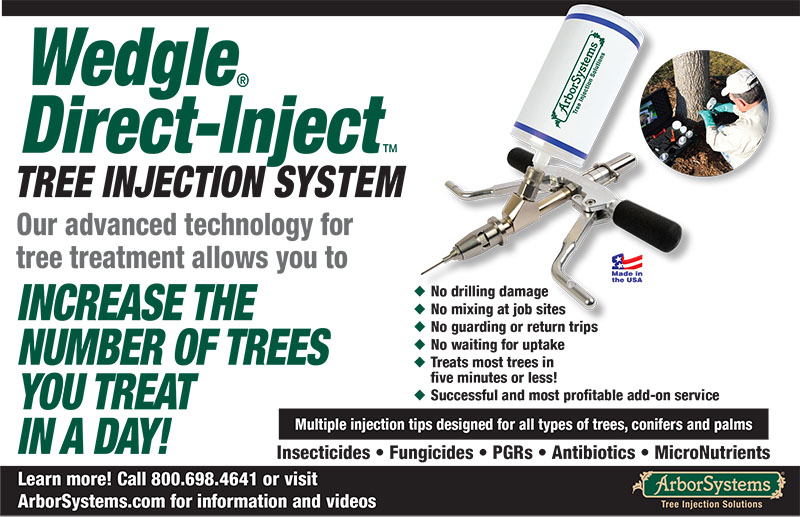
Delivery systems are also seeing some new innovations: The Wedgle from ArborSystems is designed to offer an alternative to what Doolittle calls the “drill and tap” methods. The device injects chemicals directly through the bark without the need for drilling.
He said the vascular system remains undisturbed, maintaining nutrient movement, and the process only takes an estimated 15 seconds per injection site, with an even smaller amount of chemical required.

“We’re not wasting the chemical in the wood of the tree where it locks up,” Doolittle stated. “We’re putting it all in the outer ring of xylem and that’s where 95% of uptake is.”
Industry experts are also predicting a change in the chemicals themselves: Neonicotinoids (often called “neonics”), a class of synthetic, neurotoxic insecticides, were created to replace the harmful organophosphates, but now even the neonics are facing increasing restrictions.
“People are going back to using organophosphates, which are a little more hazardous, but legal,” Brewer explained. “Right now, there’s still kind of a gap… So, I think you’ll see safer replacements start to come out in that department.”
While treatment will never be a one-sized-fits-all approach, arborists should instead strive to understand the biology, chemistry, site conditions and the customer’s goals when considering the right approach. And when used thoughtfully, both micro- and macro-injections can deliver long-term sustainable plant health care.
Where Science Meets Stewardship
For all the advances in chemistry, delivery systems, and diagnostics, the future of plant health care will still depend on sound arboricultural judgment. New products may become more targeted, less invasive, and more environmentally compatible, but no injection, drench, or spray can replace a thorough understanding of tree biology and site conditions.
As the PHC toolbox continues to expand, arborists will have more options than ever before. The challenge — and the opportunity — will be knowing not just how to treat a tree, but when treatment is appropriate, what outcome is realistic, and how to balance efficacy, cost, and environmental responsibility. In that sense, the future of plant health care is not simply about better products.
It’s about making better decisions.