Lower the Load
And Prevent the Tip-Over
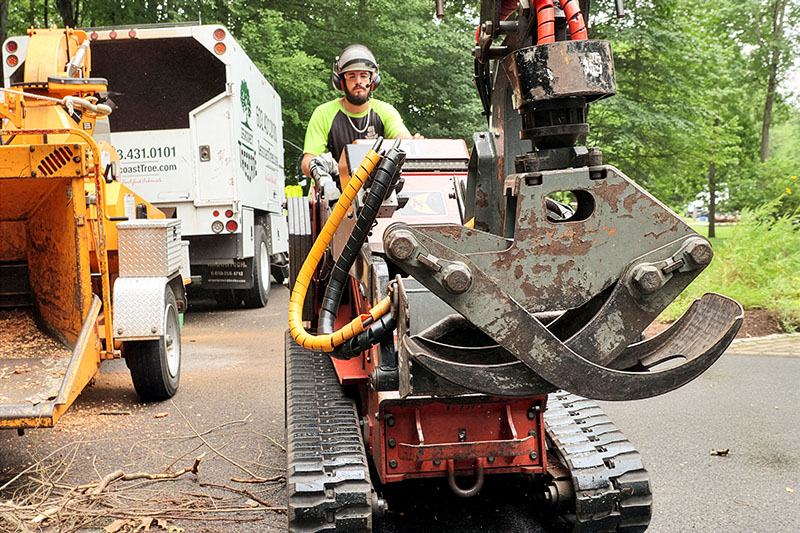
The following observations are based on an interview with Evan Englehart, general foreman at Seacoast Tree Care in Stratham, New Hampshire, conducted during a residential tree care job.
Tree work puts heavy equipment to work in conditions that would make safety professionals in other industries wince. There are sloped residential lots, tight driveways, overhead power lines and, often, all of it within a stone’s throw of someone’s living room window.
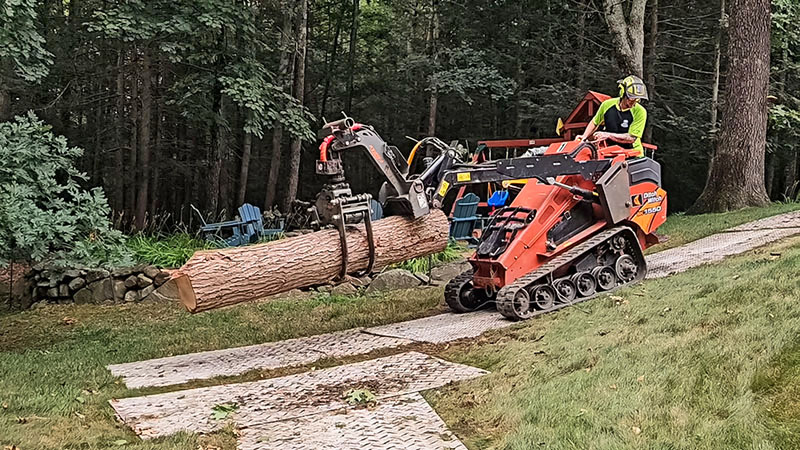
Skid steers and grapple trucks, sometimes called log loaders, are two common pieces of heavy equipment on a tree crew, and they have at least one major thing in common. Beyond the grapple — often jokingly called the “grippy, clenchy thing” that moves tree debris — both machines can lose stability under load and tip-over.
Does this type of incident happen frequently? It is difficult to know. These incidents are often unreported, particularly when no one is injured. But the potential for a tip-over is real, and it can have serious consequences when it happens.
The possibility of a mini loader tipping under load increases when the operator receives poor training, or no training at all. Much of what it takes to keep these machines upright under load is passed down from crew to crew rather than found in the manufacturer’s operating manuals. Equipment can change faster than the literature can keep up.
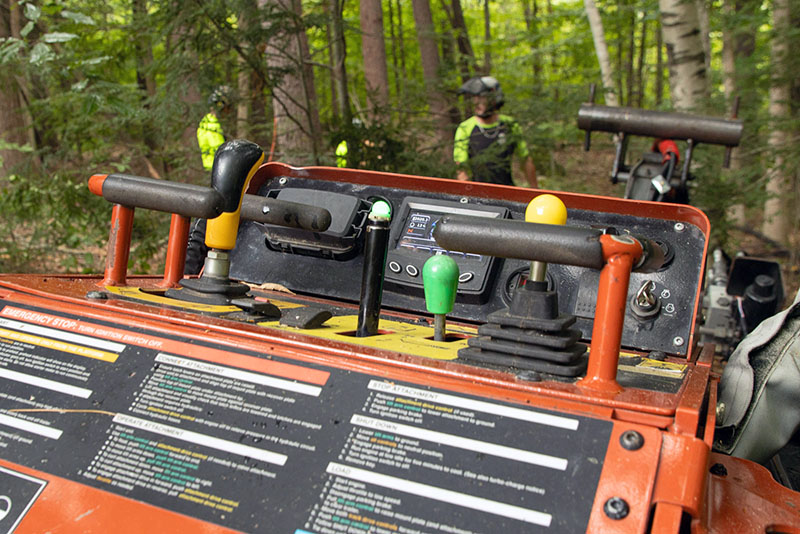
Operators may also overlook the manuals, while the manuals themselves rarely capture everything crews learn through experience in the field. The manual that comes with a skid steer or log loader is an important starting point, but it is not the complete picture.
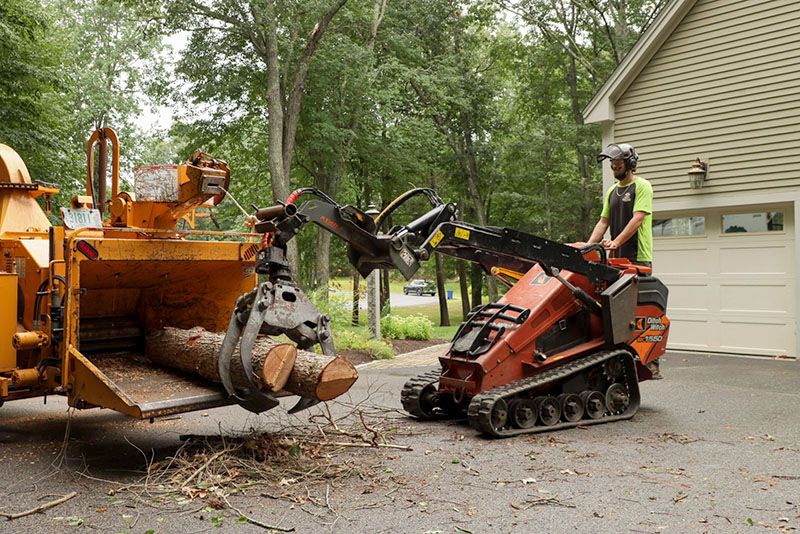
During a residential tree removal, Evan Englehart, general foreman for Seacoast Tree Care in Stratham, New Hampshire, took time to explain the work as the crew operated a skid steer and grapple truck. Throughout the day, he informally shared the rules he follows when operating both machines.
“What emerges are two different stability problems,” he noted. “A low, tippy machine versus a heavy one with a small footprint.”
Despite the difference between the two, Englehart said there is one shared response when something starts to go sideways:
Drop the load the moment it feels wrong.
Skid Steer/Mini Loader: Three Rules for Staying Upright
Let’s begin with the skid steer, or mini loader. Three rules came up during the conversation, and each one addresses a different way these machines can hurt someone.
Rule 1: “Eyes in the back of your head.”
This is not a throwaway line. It is the practical response to one of the most common ways someone can get hurt around a skid steer, and it has nothing to do with the machine tipping over. It has everything to do with what is behind it.
On a tree removal job, you are driving backward much of the time. Skid steer work involves considerably more reverse travel than forward travel, which means operators have to maintain constant awareness of what is happening behind the machine.
That awareness extends beyond simply watching for people. The operator also must account for obstacles, changes in grade, debris, and the changing position of other equipment and crew members. In a busy residential work zone, what was clear a few seconds ago may not remain clear for long.
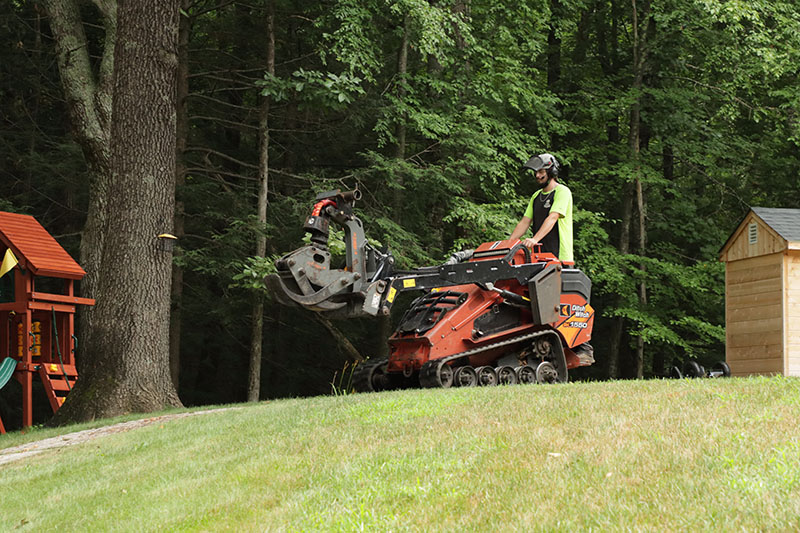
Rule 2: “Don’t cross a slope; climb it.”
Driving across a grade instead of traveling straight up or down it is one of the fastest ways to roll a skid steer. At its core, it is a center-of-gravity issue.
Angling across a hill shifts the machine’s center of gravity outward and quickly eats into the safety margin available for travel. Add a load to the equation, and that margin can shrink even further.
The safest route is generally the one that keeps the machine aligned with the slope rather than allowing the load and machine to lean sideways across it. On a residential property, however, that is not always the easiest route. Tight access, landscaping, driveways and other obstacles can make the terrain difficult to navigate, which is why understanding how the machine responds to the grade matters so much.
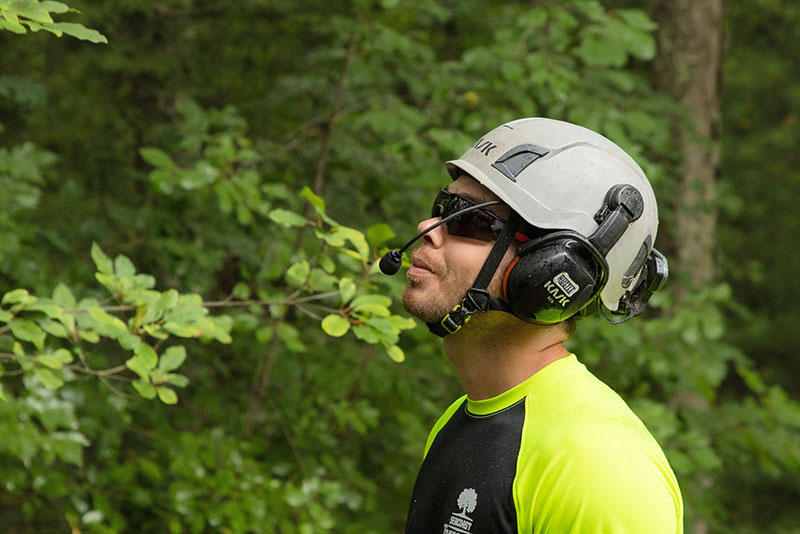
Rule 3: “If it’s too heavy, put it down.”
When a load exceeds what the machine can safely lift and begins to cause a tip-over, the order of operations is straightforward: Make sure everyone is clear, then shut down the engine so the machine is not also damaged in the process.
But the real lesson happens before any of that.
New operators may panic and freeze when a machine begins to feel unstable rather than simply setting the load back down. That hesitation can be what turns an unstable situation into an actual tip-over or equipment damage.
The rule exists to short-circuit that pause. If the load feels wrong, put it down.
It is a simple response, but it requires an operator to recognize the machine’s warning signs before the situation becomes unrecoverable.
Grapple Truck/Log Loader: A Different Kind of Heavy
The grapple truck’s stability problem is different from that of a skid steer. It is not necessarily about being top-heavy and tippy. Instead, it is about sheer mass meeting a relatively small contact patch.
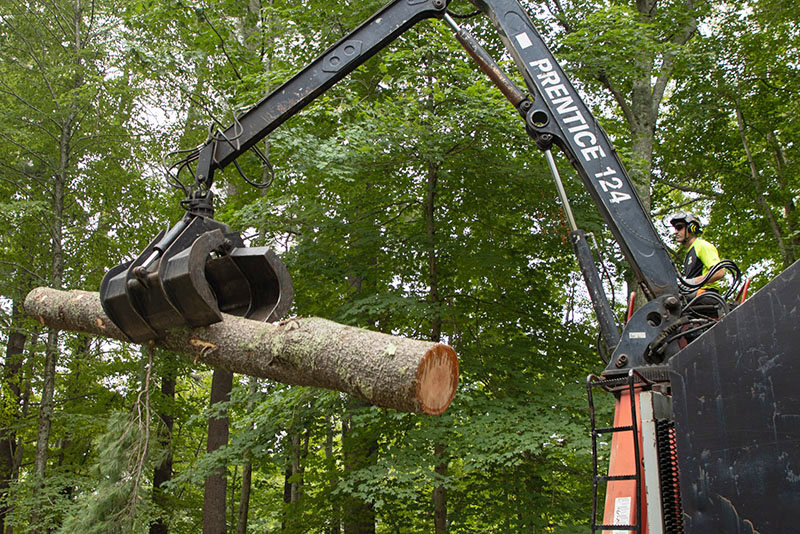
Unloaded, the truck weighs more than 40,000 pounds — more than twice the weight of a typical bucket truck — and all that weight has to be supported somewhere. Once the grapple begins reaching, lifting and pulling material from different positions around the truck, the forces acting on that weight change.
Here are four rules the Seacoast Tree crews follow without exception.
Rule 1: “Set it up right or you’ll leave a mark.”
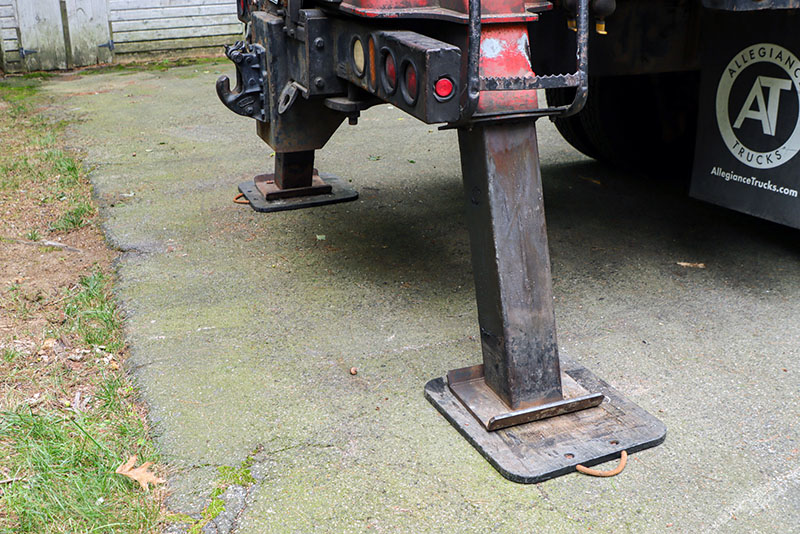
Outriggers on solid pads are a must. The grapple’s footprint is small relative to the truck’s total weight, and skipping the setup step can leave a divot in someone’s driveway even when nothing goes wrong mechanically.
Proper setup is therefore about more than preventing a tip-over. The ground itself becomes part of the equation. A machine that is stable on solid, properly supported ground can behave very differently when an outrigger is placed on an unstable surface or when the weight is distributed poorly.
Rule 2: “Stability is still a feel thing.”
Just like the skid steer, there is no single gauge telling the operator when the machine is safe under every possible load. The operator has to understand how the chassis responds as the grapple reaches, lifts and pulls.
You raise the chassis until it feels solid, and lateral loads — most pulls come from the side — are the main thing to watch.
The fix, again, is the same: If it feels off, put the load down.
There is a wrinkle, though. Pulling a load closer to the truck increases lifting capacity, but the debris body can only hold so much. Pack it too tightly, and the load may become difficult to unload later. Englehart compared the process to playing Tetris: Material has to be positioned efficiently without creating a problem for the next step.
That balance between lifting capacity and usable space is another example of why operating these machines involves more than simply following a set of numbers. The operator is constantly reading the machine, the load, and the environment together.
Rule 3: “Don’t close the jaws all the way.”
The grapple on this truck uses a clamshell rather than the thin, bypass-style jaws found on many log trucks, so it grips material differently.
The jaws should be positioned below the horizontal midpoint of the load, allowing them to cradle the material while leaving some closing travel. If bark slips or compresses as the load is lifted, the jaws can tighten farther without losing their grip.
It is a small adjustment, but it illustrates the larger point: The way a load is positioned within the grapple matters just as much as the amount of material being lifted.
Rule 4: “Ten feet, no exceptions.”
Stay outside the minimum approach distance — typically 10 feet or more — with no judgment calls.
None of the truck is insulated, so it is treated like any bare conductor when operating around overhead power lines. Ground crews are taught to stay clear of the machine any time it is working near power lines, full stop.
That distance is not a matter of how experienced the operator or ground worker feels. It is a boundary that remains in place regardless of how routine the work may seem.
Different Machines, Same Lesson
What is interesting is that two very different machines ultimately teach the same lesson.
A skid steer can tip because it is relatively small, with a compact footprint and a load that can quickly alter its center of gravity. A grapple truck can become unstable because it is enormous and is transferring that tremendous weight through a relatively small footprint while reaching and pulling material from different angles.
Different physics, but the same basic response: Notice the problem early and let go rather than trying to muscle through it.
That may be the real skill being trained here. It is not simply How do you operate a skid steer? Or, how do you run a grapple truck? It is closer to: How quickly can you recognize that something is wrong, and how quickly can you react?
That instinct is difficult to capture completely in an operator’s manual. Manuals can explain operating procedures, capacities and manufacturer recommendations, but they cannot always replicate the experience of standing beside a machine and learning what it feels like when a load is starting to become unstable.
Where the official manuals leave room for experience, this crew seems to rely on a portable rule of thumb: Read the machine, recognize when something feels wrong; and if it does, put the load down.
Whether that same instinct translates across other crews and equipment, or whether it is more specific to the experience and practices of Seacoast Tree Care, would require a much broader look than one job site can provide. But on this residential removal, one lesson came through clearly: Knowing when to let go may be just as important as knowing how to lift in the first place.